
About

Products
Freebies

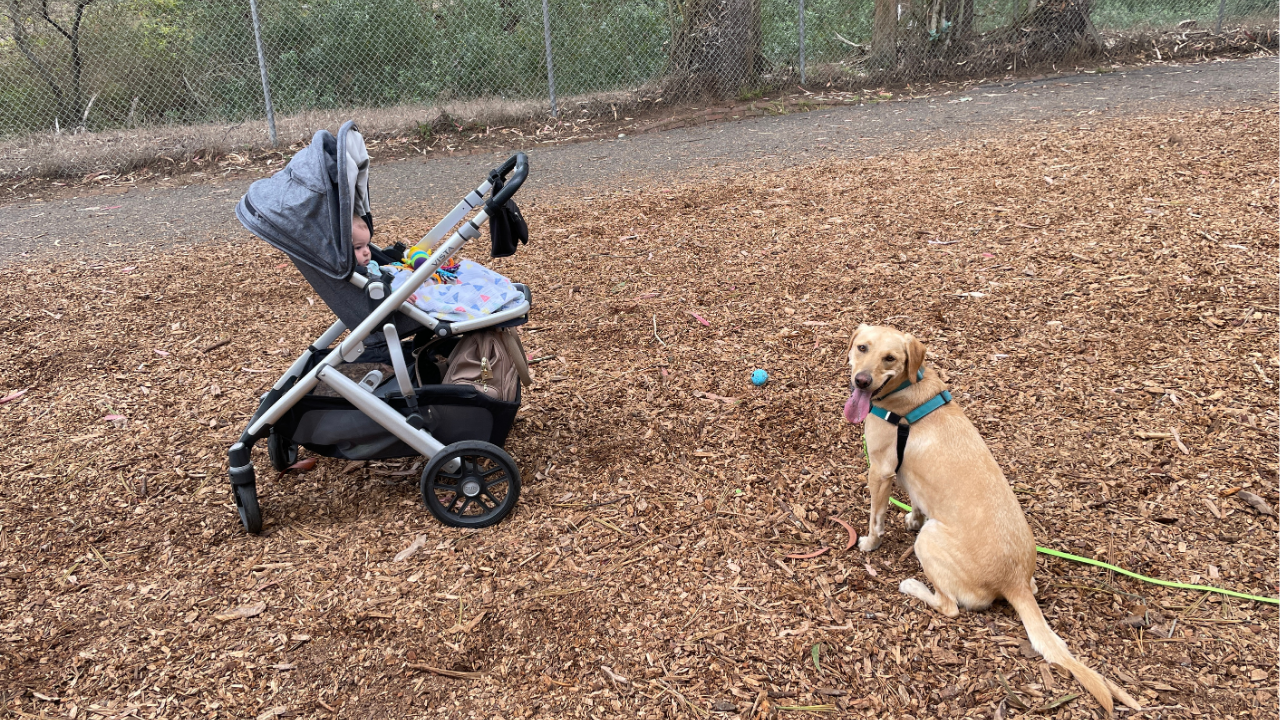
Every time I post about grief, guilt, or resentment toward the family dog after bringing a baby home, that post gets shared and commented on more than almost anything else I put out.
In fact, our last Instagram carousel post about grief went viral and had over 3 million views.
The reason: many new parents, mostly moms, feel seen and their feelings are validated. They don't feel alone.
Recently, I've been seeing more and more parents posting about postpartum pet aversion. Will every new parent end up resenting their beloved dog?
Absolutely not.
In my professional experience as a dog trainer, feelings of resentment often happen to the parents who are the most engaged dog parents, the ones whose dog is genuinely their furbaby.
When you're busy taking care of a newborn, too tired, too sleep-deprived, and often too touched-out to spend time with the dog, normal dog behaviors start to feel like too much. The shedding, the barking, the licking, the constant asking for pets. Even your dog staring at you lovingly can start to feel like judgment.
Many dogs change their behavior during pregnancy. Some become clingy and protective, spending most of their time by mom's side. When that attention abruptly ends after the baby arrives, some dogs start "acting out" right when you have the least time, energy, and patience for new behaviors. That's often exactly when the resentment or pet aversion starts creeping in, even when you're aware it's happening and don't want to feel it.
Becoming a parent is a massive identity shift. If you don't have much help, have a medical baby, or are simply exhausted, those feelings toward your dog can get amplified fast.
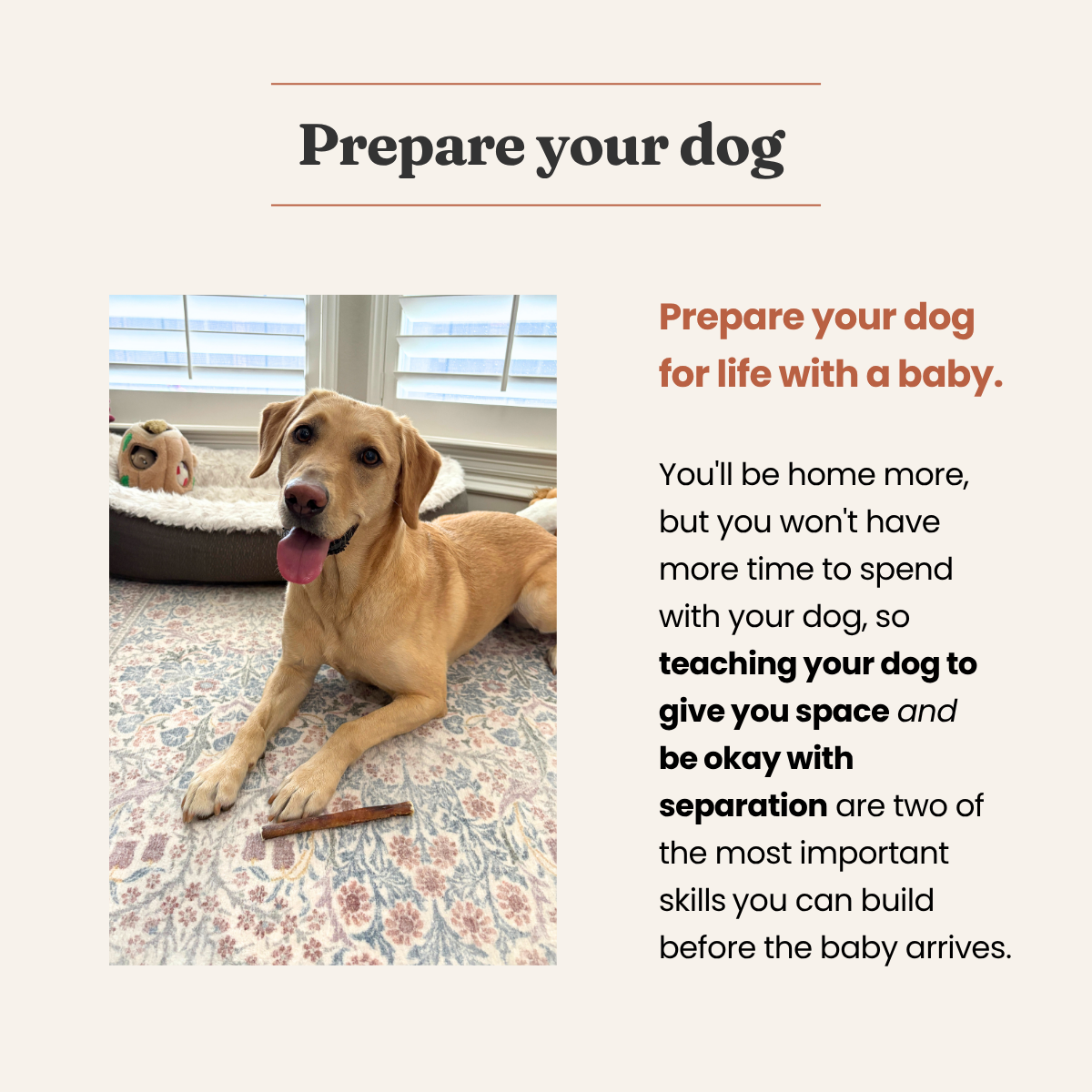
Have a plan for the fourth trimester. Ask a neighbor, friend, or family member for help with your dog. Hire a professional dog walker, or a responsible neighborhood kid to play fetch in the backyard.
Keep your dog's brain busy. Puzzle toys and safe chews go a long way toward keeping your dog occupied and content when you simply don't have the bandwidth to entertain them.
Find one thing you both still enjoy. In the early postpartum days, once I felt physically able to get out after my C-section, a one-on-one walk with my dog Lola to our favorite park did more for how I felt about her than anything else. It wasn't about "making time", it was doing something we both genuinely liked, together, without the babies in the mix for thirty minutes.
Ask for help. If it is worsening or causing significant distress, you do not need to wait for it to pass before seeking support.
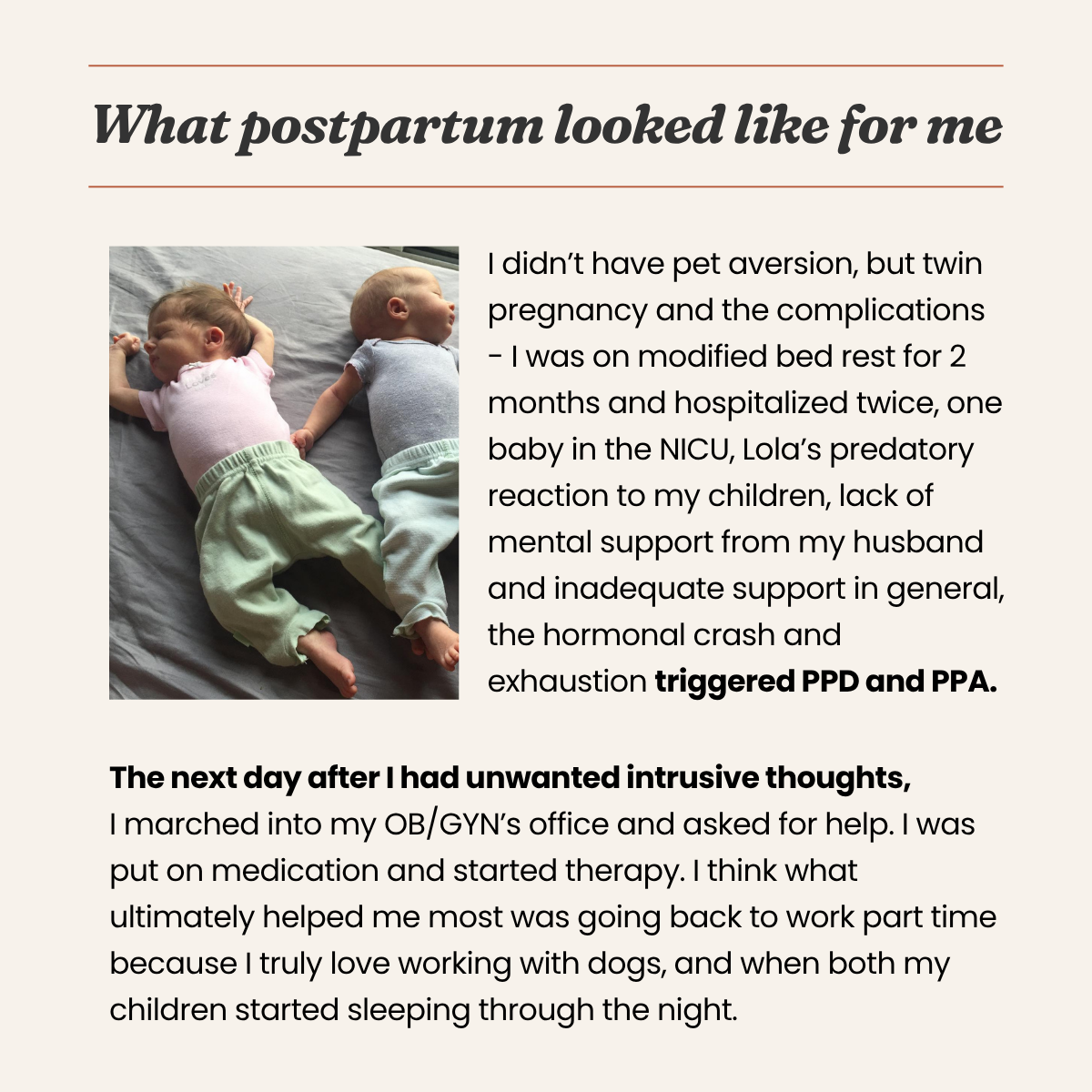
I've worked with many new parents who resent their dog and feel deeply guilty about it, some to the point of considering rehoming, convinced their dog deserves a better, more attentive home than they can currently give.
I asked Caitlin Slavens and Chelsea Bodie, the founders of Mamapsychologists and Couples to Cradles - perinatal psychologists who work with new moms every day - for their take on postpartum pet aversion.
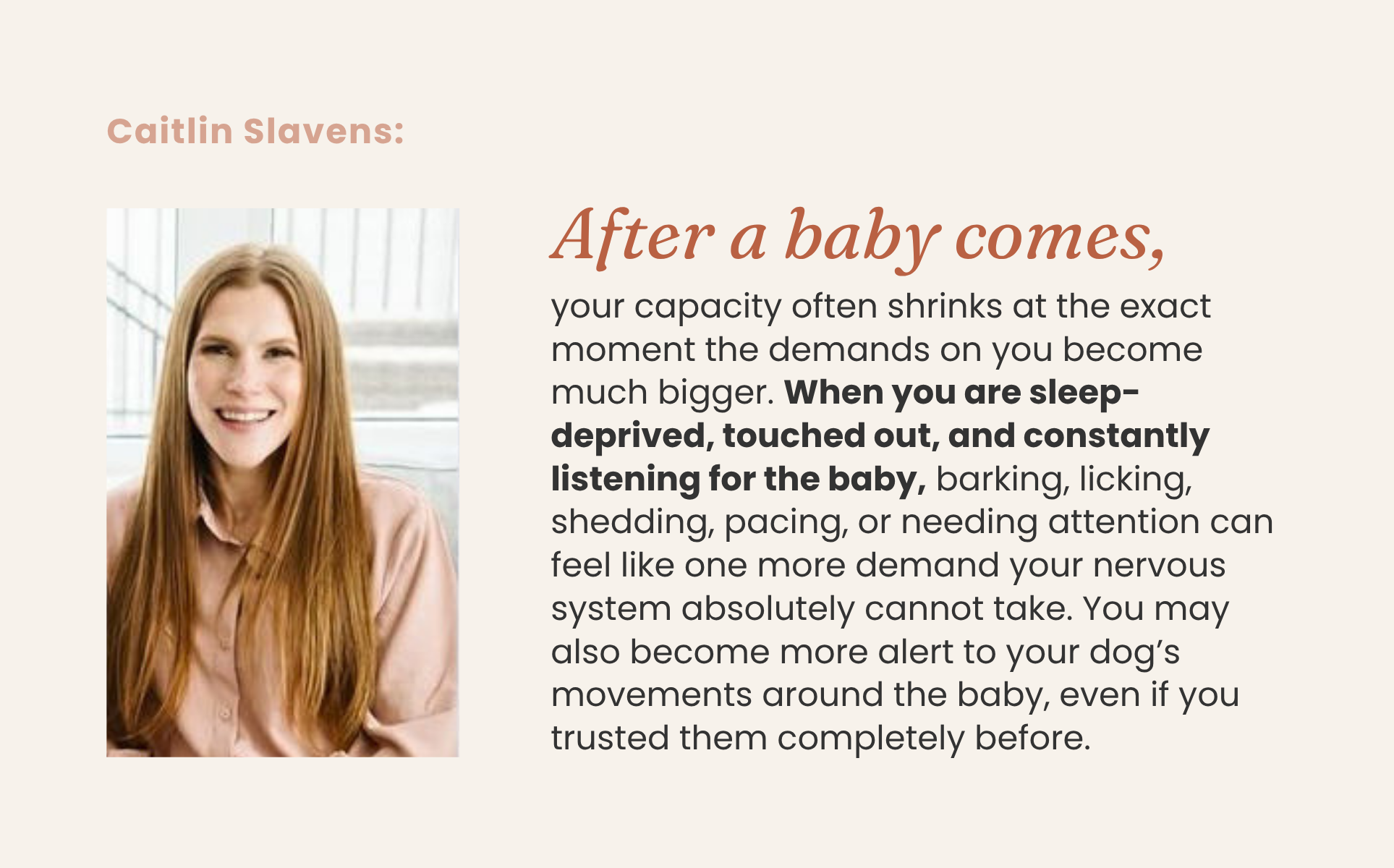
The guilt often comes from comparing how you feel now with how deeply you loved your dog before. But feelings are not actions. Feeling resentful during an overwhelming period does not mean you have stopped loving your dog or that you are a bad person.
If it is accompanied by ongoing anxiety, rage, hopelessness, excessive guilt, loss of interest, difficulty sleeping even when you have the opportunity, or trouble functioning day to day, it is worth speaking with a healthcare provider or perinatal mental health professional. Unwanted intrusive thoughts are not the same as wanting to act on them, but they still deserve compassionate, informed support.
After we published our recent blog post, Jessica reached out to share her story about how rehoming ultimately became the best decision for her family and her dogs. Reading her message made us realize our post wasn't truly complete without her perspective.
Thank you, Jessica, for your vulnerability. I know this will help so many parents who are silently struggling right now.
“Thank you!! I think it’s so needed that more people know about it. I’m so grateful you are posting about it.
For me, it was like a light switch flipping. One day they were my literal babies that I couldn’t adore more and I was so anxious to make everything perfectly comfortable for them at all times—that’s why I started following Dog Meets Baby because I wanted their introduction to my firstborn to go perfectly. But then, once I reached the delivery room, I couldn't have cared less.
It left me in a world of feeling guilty about having such negative feelings about my dogs, and knowing that if I were to rehome them it’s almost like being “canceled” in the dog community. It’s the unthinkable, most horrific thing you can do to a dog in so many people’s minds. And it was in my mind for years, so it kept me holding onto them longer than I should have, honestly.
Until I remembered my first childhood dog. I had a dog my mom wouldn’t let me pet and he was an outside dog. She said he was too stinky and old and rolled in his poop so you couldn’t touch him. He lived such a lonely life until they had to put him down. That made my heart hurt and made me think—how much better of a life would he have lived if they had just given him to someone else who wanted him?
And I was kind to my dogs until we rehomed them, but I wanted them around less and less, and I was always frustrated when they were in the room. It finally became clear to me that giving them away wouldn’t be the selfish thing to do—it would be the best thing to do for them. My daughter didn’t play with them much, my husband didn’t either. I was the one doing the most to take care of them even though I liked them the least—because I knew it was the right thing to do—petting them only because I knew I should, not because I wanted to.
It sounds horrible and it is horrible! I hate that I had that switch flip. I wanted to go back to the way it was and I feel sad I couldn’t. I miss the feeling of how it felt before with them, but it felt like I wasn't even that person anymore—I couldn’t translate it to my new life with kids. I tried to overcome my aversion, but after 5 years I finally rehomed them before my second baby.
They truly deserved someone who wanted them. I stay in touch with the people I surrendered them to and we plan to meet up once in a while. I’m so happy they are happy now and I’m able to not feel horrible every single day. Just sharing my story because I truly think sometimes it’s best for both the dog and owner if the owner can’t stand them. I got so much hate for rehoming them—SO much HATE. But they are living their best lives being adored.
So all that to say—thank you! Thank you for being a platform that voices the very real reality of this aversion that comes on and sometimes doesn’t leave, and for voicing how sometimes the best thing to do for everyone is rehoming.”
Talking to other parents going through the same thing helps a lot. At Dog Meets Baby, we run a support group for parents in our online courses. The goal is to connect parents of little kids and dogs with other parents who genuinely understand the everyday challenges of raising children with dogs because they're in it too.
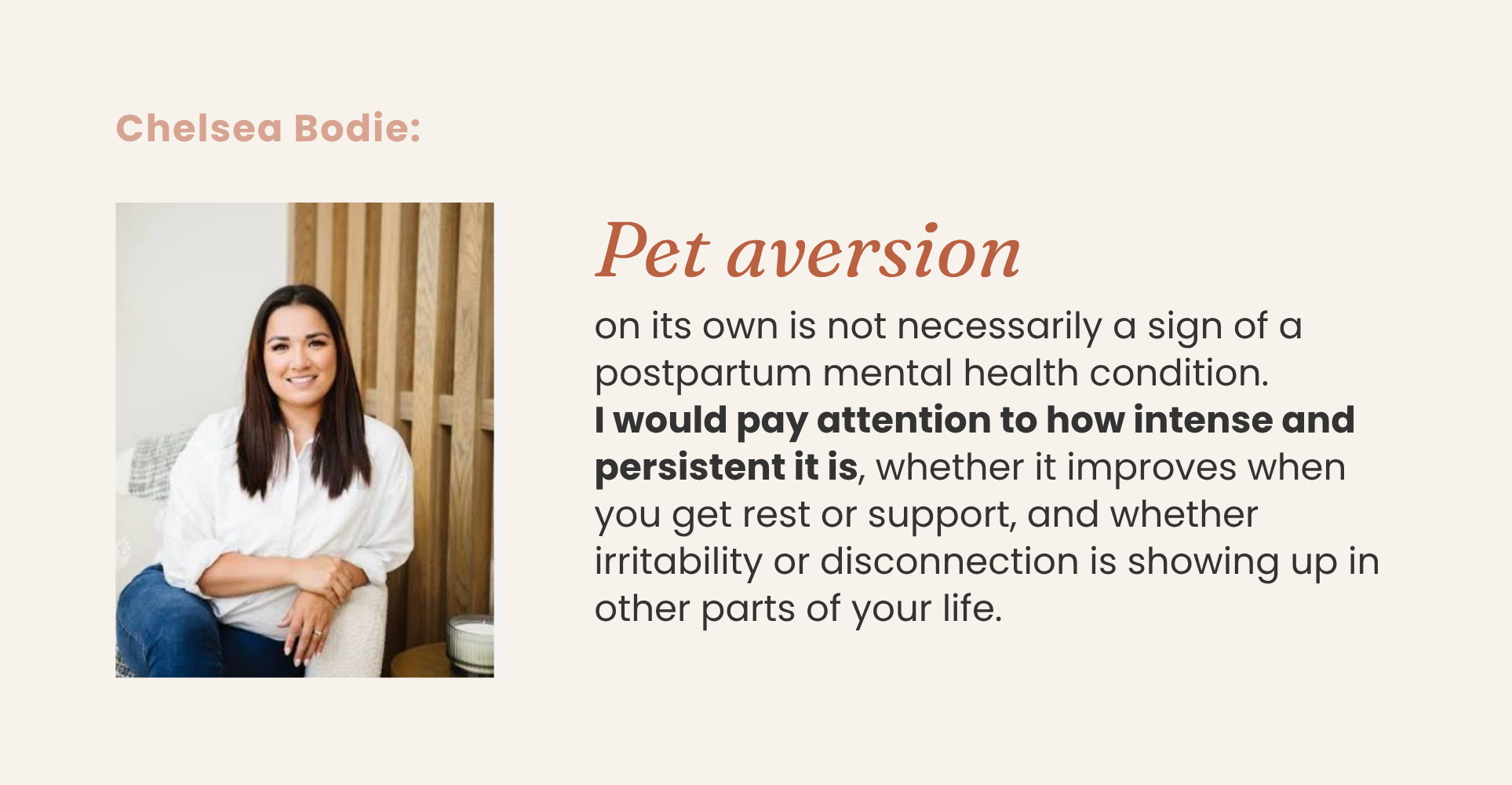
You are not alone. You are not a bad parent. These feelings are usually temporary. As Chelsea has shared, pet aversion on its own is not necessarily a sign of a postpartum mental health condition. Pay attention to how intense and persistent it is, whether it improves when your baby starts sleeping longer stretches and you get rest or support, and whether irritability or disconnection is showing up in other parts of your life. There is no standard timeline because postpartum pet aversion is not a formally defined condition. For many parents, it comes in waves and begins to ease as sleep, support, and daily routines improve. For others, it lasts longer, particularly when postpartum depression or anxiety, relationship stress, or concerns about the dog’s behaviour are also present.
What is postpartum pet aversion?
Caitlin: Postpartum pet aversion is a term parents use to describe feeling unusually irritated, overwhelmed, disgusted, or resentful toward a pet after having a baby. It can be connected to sleep deprivation, sensory overload, feeling touched out, heightened protectiveness, and having very little capacity left for another being who needs something from you.
How long does postpartum pet aversion last?
Chelsea: There is no standard timeline because postpartum pet aversion is not a formally defined condition. For some parents, it comes in waves and begins to ease as sleep, support, and daily routines improve. For others, it lasts longer, particularly when postpartum depression or anxiety, relationship stress, or concerns about the dog’s behaviour are also present. If it is worsening or causing significant distress, you do not need to wait for it to pass before seeking support.
Is it normal to consider rehoming my dog after having a baby?
Dominika: It's more common than people admit, and having that thought doesn't make you a bad dog parent. Most of the time, the underlying issue is bandwidth and preparation, not the dog or the relationship. Support, a plan for the fourth trimester, and reconnecting in small ways usually resolve it before rehoming needs to be on the table.
Chelsea: Thinking about rehoming can be a sign that a parent desperately needs some relief, not necessarily that rehoming is the only answer. Before making a permanent decision, it can help to share the dog’s care, create more separation and structure at home, and consult a qualified trainer or veterinarian about any behavioural changes. However, if safety cannot be maintained or the dog’s needs cannot reasonably be met, rehoming may be the most responsible choice. The goal is not to keep a dog at any cost or shame a parent for recognizing their limits.
How can I reconnect with my dog after having a baby?
Dominika: Small, low-effort moments count more than big gestures right now: a short one-on-one walk, or a few minutes of quiet cuddle time help rebuild the connection without adding pressure.
I would lie on Lola’s dog bed after the 3 am feeding for a few minutes. Hearing her heartbeat and feeling her warm body was my favorite part of the nighttime routine.
How do I prepare my dog for a new baby before they arrive?
Dominika: Start during pregnancy: practice short separations with a baby gate or closed door, train your dog to settle on a bed or mat, and build in some independence so your dog isn't relying on constant attention the moment the baby comes home.
Helplines and Text Support
Professional Healthcare
Helpful blogs written by Caitlin Slavens:
Postpartum Therapy in Alberta, Canada:
At Couples to Cradles Counselling, Caitling, Chelsea, and their team specialize in maternal mental health therapy. They support parents across Canada, with:
Dog Meets Baby is reader-supported. When you buy through links on this page, we may earn a small commission at no cost to you.
Online resources to help your baby and dog get along—right from the start and as they grow up together.


.png)
