
About

Products
Freebies


Does your dog steal your baby’s toys, diapers, pacifiers, or clothes? Sometimes you get lucky and your dog magically KNOWS not to touch the baby's toys. But, if you’re like most, you need a strategy for keeping your baby's stuff out of your dog's mouth, and your dog out of harm's way.
Babies bring A LOT of new and organic smells that are exciting to your dog. Dogs are natural scavengers. Scavenging is a survival mechanism and an instinct that’s strong in most dogs. Introducing a baby to your house can potentially trigger your dog’s scavenger tendencies in new ways.
Many baby items can be stimulating for your dog, or even mistaken for food.

If your dog gets, consumes, or destroys one of these things, don’t panic; it’s no different than your dog eating food you accidentally left at their level or (easily) accessible. Depending on the culprit, you can resolve the situation 1 of 2 ways. 1) You may monitor the dog at home and your dog may have an upset tummy for a day or two. Or 2) you may need to rush your dog to the ER for emergency surgery, to induce vomiting or stomach pumping, fluids, and overnight monitoring.
Always call your veterinarian if your dog consumes something potentially dangerous or call ASPCA Animal Poison Control Center at 888-426-4435 (US) for directions (there is a fee but it is well worth it).
In a poll, my followers on Instagram have shared an impressive list of baby and toddler items their dogs have ingested:
Possible health issues
This is not an exhaustive list! Always check with your veterinarian immediately if you have any concerns.
Dr. Lisa Lippman, DVM, shares many useful tips on her Instagram account.

Practical tips
1. No squeaky toys for your child if your dog is obsessed with squeaky toys.
2. Watch out for possible choking hazards. Some baby items look like toys, some have small pieces (e.g., a chew necklace made out of silicone beads or teddy bear eyes) that could be a choking hazard or cause intestinal blockage.
3. If your dog steals wooden toys and chews on them, get them their own chew! Check out our blog post on chews here.
4. Teach your dog “Leave It” and "Drop" cues. Not sure how? Watch this short training of me teaching 6-month-old Rosie the Leave IT cue.
5. Teach your dog which toys are his/hers through redirection. Be consistent.
6. Gates gates gates! Go to Dog Meets Baby Amazon Store to check out baby gates and playpens recommended by me, my clients, and my followers.
We invested in a long Toddleroo gate, and even though it was a bit pricier, it easily turned out to be one of our best baby-dog purchases. It’s remarkably sturdy and looks great in our home, but its real value has been how it evolved with our family. Early on, we used it to keep toddlers and dogs safely separated. As the kids grew, it transformed into their private "office"—a safe zone where Lego builds, drawings, and school projects stay safe from Lola, Hela, and our guest dogs. When Hela was a puppy, it helped us section off areas off-limits to sharp little teeth. And in a pinch? It’s even doubled as a drying rack.
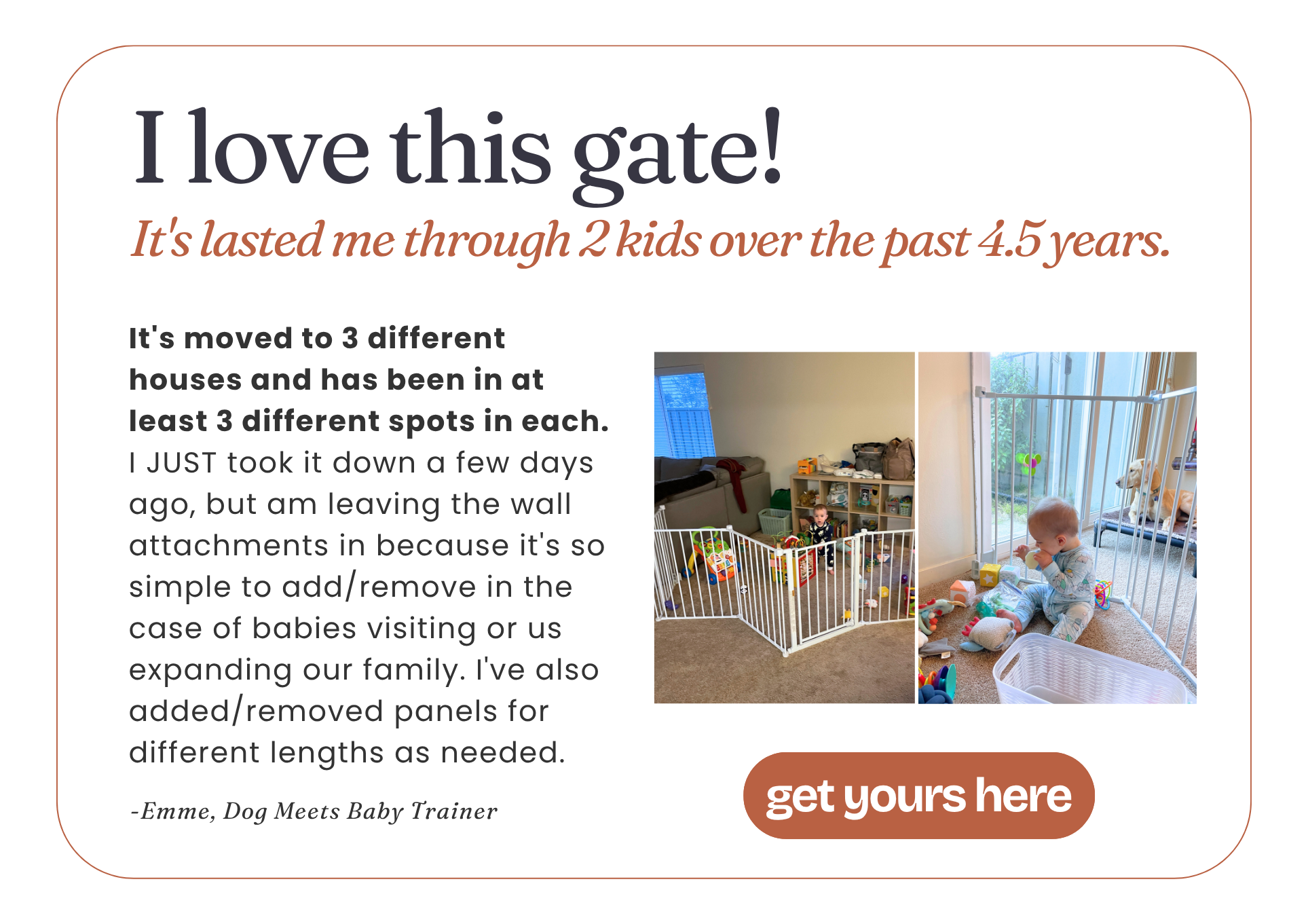
7. Baby toys in baby-only zones and dog toys in dog-only zones.
8. Keep the most tempting toys out of reach if your dog is only interested in certain types of toys.
9. No stuffed or plush toys for your dog to help your dog distinguish. Easier done when you have a puppy.
10. Create designated spaces for dogs and kids.
Are you nervous that your dog is going to trample your baby trying to get to a toy without even realizing it? Teach your dog that baby space is off-limits by practicing the leave it cue, redirecting, teaching your dog to stay on their bed, and body blocking. This way everything that is in the baby's space is off-limits. Here is my simple and effective way to train Go to Bed. Waffles is an 8-month-old easily distractable puppy and this method worked like charm.

Cues like ‘drop,’ ‘leave it,’ ‘back up,’ and ‘stay’ can make play situations more controlled, calmer and safer. Or you can manage by playing in a different space from your child.
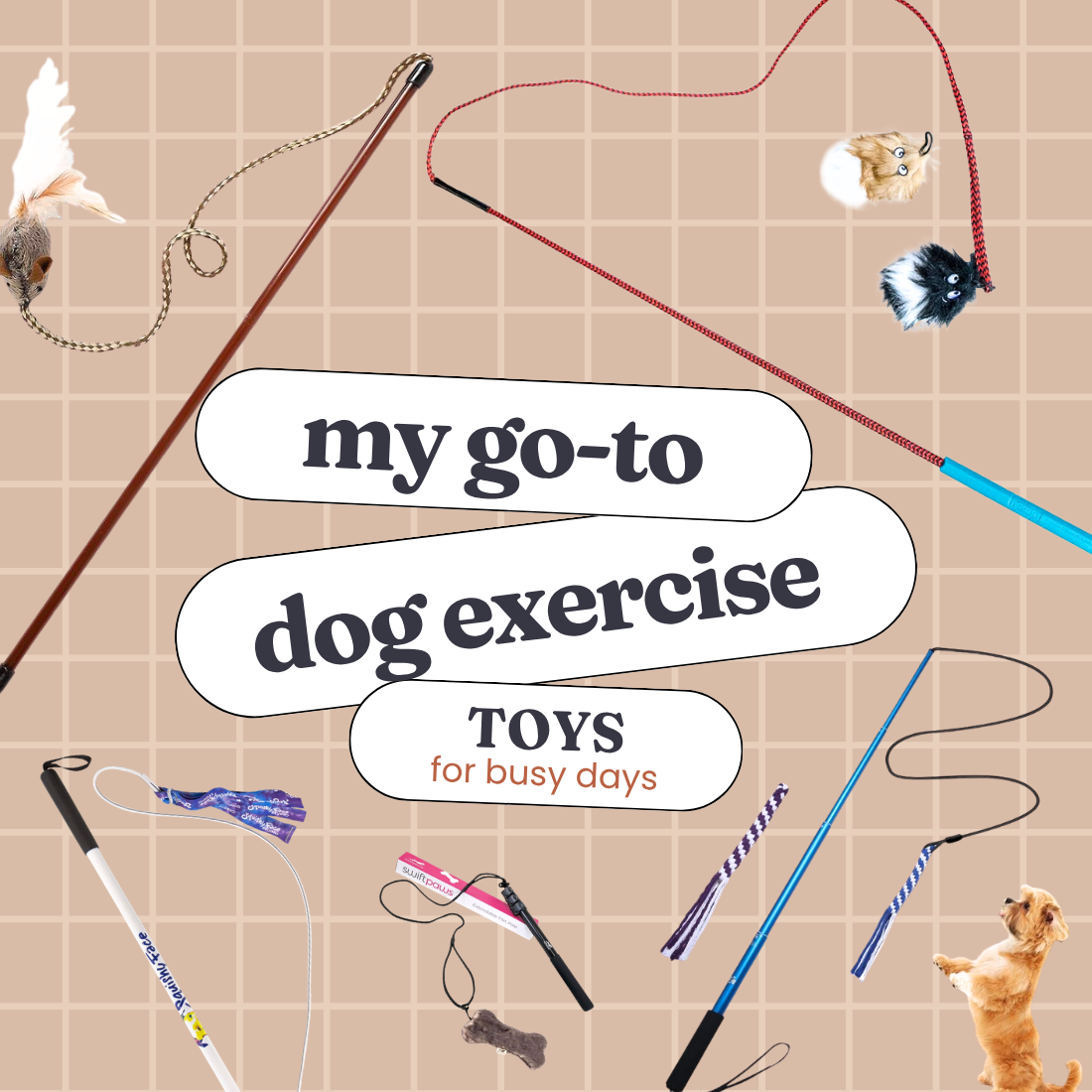
The flirt pole is my go-to toy for exercising my dog when I don’t have much time. I have tested all three flirt poles and I like each one of them for different reasons.
If you have a tiny dog, you can use a cat wand toy.
While many dogs attempt to steal baby’s toys, there are many ways to stop them from doing it, through training, redirecting them to their toys and chew toys and management. In my book, management is equally good, you don’t always have to train! But if you enjoy the training, subscribe to my YouTube Channel where I share short training videos with easy-to-follow steps.
Online resources to help your baby and dog get along—right from the start and as they grow up together.


